
How To Get Rich & Die Trying Pt II: The Law of Diminishing Returns
MAY 5TH, 2026

On the pharmacology of power
Sam Altman was once asked how many “good hours” he gets in a day.
I mean, if you take armodafinil or something you get 20.
Garry Tan on Twitter: “I did modafinil 15 years ago to work harder because I had to. I don’t need that today because it’s not all on me anymore.”
This is a piece exploring that [had to].
There’s a concept in evolutionary biology to explain the way in which organisms must constantly adapt; not to get ahead, but to survive relative to everything else that’s adapting. It’s called the Red Queen.
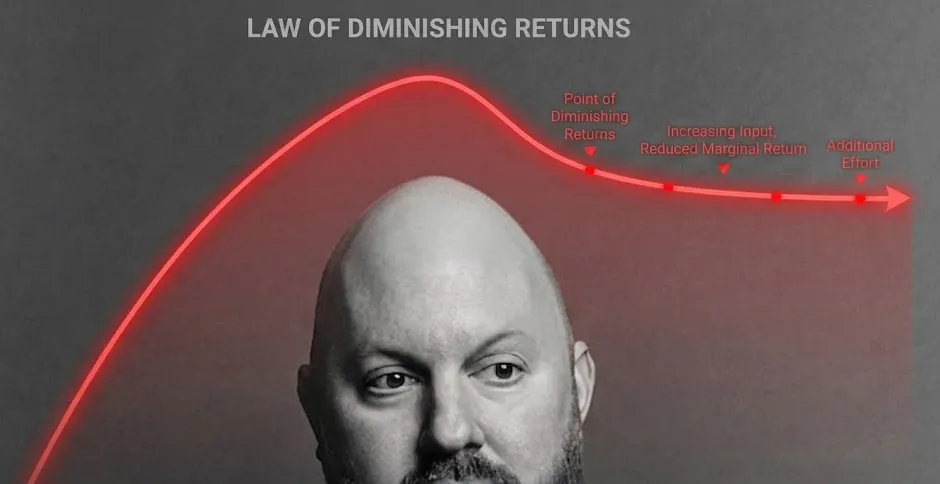
Yes, that Red Queen, from the scene in “Through the Looking-Glass” where Alice has to run as fast as she can, just to stay in the same place. As the baseline shifts, the returns on the things you have to do are moreso defensive rather than additive.
Just like an Olympic athlete who’s willing to do almost anything, even if it shortens your life by five years, to get a gold medal, you’re going to think about what pills and potions you can take. In many people’s minds, the difference between completely failing and making a billion dollars, is right here (pointing to his head). — Tim Ferriss
There is a pharmacological architecture that exists in the language of this race to the top; it’s spoken by the people whose goals require them to be functional for more hours than their nervous systems can sustain. That [had to] feeling Tan describes is the outcome of a competitive environment where the baseline for “functional” has moved past natural human capacity. Step into that mindset 24/7 and things can get extreme.
During the years Bryan Johnson was building Braintree, he’s said of the experience: My body and mind were trashed in every way for 23 years. Chronic depression, obesity, terrible sleep, raising 3 kids, startup founder/CEO grind culture behavior (and even growing up w/ excess sugar, sun exposure, junk food.)
Johnson recognized the damage as damage and, after those 23 years, he could afford the repair. This repair would eventually become Blueprint, the longevity project designed to reverse aging. Johnson’s Blueprint is essentially an extreme version of “Chapter 11 Bankruptcy” for the human body. It’s the filing you make after 23 years of “just one more month of grinding” erodes your capacity to see what you were even building towards in the first place, let alone what the cost truly was.
Unlike competitive athletics, which has been rocked more than a handful of times by its doping scandals, Silicon Valley will never have its Livestrong moment.
Modafinil, armodafinil, bromantane, ketamine, Adderall, peptides, microdosing, the Clavicular stack, the Androgenic stack, the Rogan, Ferriss, or Huberman protocols. You can openly discuss your participation in any/all of what's listed and no one bats an eye. In business, as long as your output is measured and impressive, people don’t care how you got there.
Sports banned doping after a very public death. In 1967, British cyclist Tom Simpson died during the Tour de France. That same year, the IOC formally established the Medical Commission and published the first list of prohibited substances.
But nobody's doing the autopsy and finding Adderall as the cause the same way they would find steroids. The founder who dies at 35 after a decade of stimulant use has their death classified as a heart attack. Cardiac arrest, seizure, overdose — but not as a pattern, and not as a design flaw.
For founders, the cognitive-stack is a leg up in a sprint to acquire an ever-shrinking slice of the pie. Anything your competition is leveraging, from stimulants to corporate tax havens, you must also leverage lest you risk getting swallowed.
Peter Thiel argued the entire goal of business is to build a monopoly. Competition is something you engage in only when you’ve failed to escape it.
This statement flips a lot of the rosy ideas regarding capitalism on its head. Assuming it’s true, what the system actually rewards is the initial act of capture and defense of the position indefinitely.
Maybe this helps to explain why the wealthiest 10% of America own roughly 87% of the stock market, or why six companies own 90% of US media. For the percentage existing outside the concentrated few—free of the money, power, or network—it can feel like the only leverage you have is your time and attention. If someone told you that you could outwork the competition in those two areas, threefold, with one pill, would you take it?
We’re seeing this play out in real time, and at a much faster pace than was likely anticipated. As the biotech crowd grows louder and money continues to funnel into the industry, more individuals are coming into contact with the looming question of how much they’re willing to endure physically, mentally, and pharmacologically to enhance the likelihood they may accomplish whatever it is they’ve set out to accomplish.
There’s certainly a romanticization of struggling, to understanding that nothing worth having comes easy. It’s difficult to grasp the idea that you don’t have to feel some pain to find the purpose of it all, but making that pain a choice, and not sacrificing yourself to it, seems to be a rarity.
Most are probably familiar with the Alysa Liu story by now: her burnout, her relationship to skating, the pressures she endured. Standard advice encouraged her to work harder, to optimize. Instead, she left skating, even when leaving was thought to be career suicide. When she returned years later, it was on her terms. She returned not because she [had to] but because she [wanted to].
This is my sport, my program.
Liu, in many ways, is an archetype of the idea that greatness isn't predicated on the decision to needlessly suffer, but the decision to willingly endure whatever is demanded of you while remaining yourself. It resonates with those who believe the "cost of doing business" is only worth it if there is still an individual left to collect the paycheck at the end of the day.
People are enamored with her because she gives shape to a fantasy a lot of us hold: that the miserable, performing version of you isn’t the only version of you that can win.
Tan took modafinil because he had to. Liu came back to skating because she wanted to. It’s the same pressures, but an opposite relationship to it. We likely won't know the long-term effects of the [had to] lifestyle for a handful of years. It's also hard to say that the [want to] approach is profitable, let alone practical, for the average non-Olympian; but what can be said is that the [had to] story stops feeling so inevitable the moment you can picture someone refusing it. The battle with either option is, after all that effort, to ultimately make sure that there's still someone to come back to at the end of it.

clear.txt
Builders, researchers, and the genuinely curious. Infrastructure informed by independent culture. all killer, no filler